

Belonging is Evangelism
The historical narrative of my great-grand mother goes something like this: In the late 1950s an indigenous woman from El Salvador, small in stature, but large in passion, would daily fill small plastic bags with rice and beans prior to traveling on the bus (el camion). She would spend the day sharing the good news of Jesus Christ with words, but those plastic bags of rice and beans represented the action behind the words, food for the body and the soul. It points to the words of John the Baptist, “Whoever has two shirts must share with the one who has none, and whoever has food must do the same.” From this ancestry derives my thinking, my posturing, my ministry and calling.
Evangelism is not only what we say about Jesus, but also about how we embody Christ. It is whether people can see themselves in the community that bears the name of Jesus.
My premise is this: The Good News of Jesus is often first experienced not in a sermon, but in the first and last moments of encounter. In multi-ethnic and intersectional contexts, those first impressions carry theological weight: they either communicate, “You belong here,” or, “You are not yet seen.”
For many people, especially those who have been marginalized, excluded, overlooked, or harmed by religious communities, belonging often comes before belief. Long before someone hears a sermon, receives communion, or joins a Bible study, they are already asking:
• Am I safe here?
• Do I belong here?
• Will anyone notice me?
• Do people like me exist here?
Before someone hears the Good News spoken, they are already reading it in how they are welcomed.
Belonging is Deeply Biblical
Belonging is not a modern strategy. It is a biblical reality.
Jesus continually creates belonging before demanding anything in return. He intentionally widens the circle of God’s love.
In Luke’s Gospel, Jesus challenges social systems that center status, power, and exclusivity. He invites people to make room for those society overlooks (the poor, the disabled, the marginalized, and the forgotten).
The Parable of the Great Banquet reveals a God who expands the table rather than protects it. Romans 15:7 reminds us: “Welcome one another, therefore, just as Christ has welcomed you, for the glory of God.”
Acts 2 portrays a community where belonging is embodied through shared life, fellowship, generosity, and mutual care.
Belonging is not meant to be performative, nor it is about perfection and certainly not about simply being nice to newcomers, there is more to authentic belonging.
True belonging is:
- Invitational, it usually ends with an invitation to the next
- Intentional, it does not happen by accident
- Curious, because one genuinely wants to get to know the person
- Makes room, by listening to the needs and desires of the other person
The First 10 Minutes are Theologically Formative
First impressions are not neutral. They are spiritual communication.
It is to say, people begin forming conclusions about a congregation within moments of arriving. In multi-ethnic and intersectional ministry, belonging is often the first experience of grace or exclusion. For many people of color, young adults, immigrants, LGBTQIA+ people, and others whose identities have often been questioned or marginalized, the Gospel is frequently experienced emotionally before it is experienced intellectually. This matters especially for ELCA Lutherans who often gravitate towards the heady rather than the instinctual.
Belonging begins with the heart before it reaches the mind. This has been my pastoral experience serving congregations full of people of diversity in Los Angeles, Honolulu, and now Washington, D.C. It is to say, that belonging precedes believing. To feel like one can belong, just the way one is, with the fullness of one’s humanity is a matter of the heart, not the mind.
And so, if congregational renewal is what you seek, then it happens when communities intentionally make room for those who have historically been left out of the story.
Growth is not merely numerical. It is not really about increasing budget, nor about survival. Instead, it is grounded in something much more complex, the sacred flow that is healing the world. Making this universe new, this cosmos whole.
- It is about spiritual growth.
- It is about racial growth.
- It is about intersectional growth.
- It is about communal growth.
- It is about human growth.
Your Website is Your First Front Door
Before the first 10 minutes of worship comes the digital front door.
Most people visit a church website or social media platforms before ever entering a church building. The question is not whether your website is polished. The question is whether it communicates clarity, authenticity, warmth, humanity, and hope.
Too many churches unintentionally create ambiguity. Ambiguity communicates:
- Uncertainty
- Hidden expectations
- Fear of exclusion
Clarity communicates:
- Safety
- Honesty
- Belonging
Therefore, clarity is a form of evangelism. Ambiguity is often a barrier to the Gospel.
People should not have to decode who is welcomed. Values should be visible. Real people should be visible. The community should be visible.
People are asking: Can I see myself here?
The Physical Front Door Matters Too
When people arrive, the church now has an opportunity to embody what it claims online.
- How is your parking lot?
- How is your signage?
- How accessible is your campus?
- How does your liturgy reflect the diversity of God’s humanity? The songs, the prayers, the sermons.
- How are visitors welcomed?
There is a difference between transactional hospitality and relational hospitality.
Transactional hospitality says: “Good morning.”
Relational hospitality says: “Good morning. What’s your name? How did you hear about us? Let me introduce you to someone.”
Belonging happens through:
- Presence
- Curiosity
- Naming people
- Making introductions
- Reducing ambiguity and fear
People are not simply joining churches. They are reading whether they can survive and thrive here.
The Last 10 Minutes Matter Too
Many churches focus on first impressions. Few focus on what happens after worship. Yet the last 10 minutes often determine whether someone returns.
The goal of those last moments you get to spend with a visitor is not membership. The goal is relationship. The goal is helping people imagine that they belong.
Who notices the person standing alone with their coffee?
Who follows up?
Who extends an invitation to lunch, coffee, a ministry opportunity, or another gathering?
Friendly churches greet people. Invitational churches connect people.
The first 10 minutes ask: Am I welcomed?
The last 10 minutes answer: Do I belong?
Practical Ways to Cultivate Belonging
Consider developing a Ministry of Curiosity. Train leaders and members to move beyond greeting and toward connection.
Practice the Rule of Three:
1. Learn their name.
2. Learn part of their story.
3. Make one connection.
Belonging rarely happens through one relationship. Belonging happens through networks of relationships.
People want to know: Does anyone care enough to know me?
Be prepared to share your congregation’s mission clearly and simply. Do you have an elevator pitch of your church’s vision and mission to share with someone in a couple minutes?
People are no longer simply looking for a church. They are looking for meaning. They are looking for communities whose values align with their hopes for the world.
A Final Word
I realize that some of this may sound more strategic than spiritual. More systemic than organic, but let me temper that perspective with some wisdom from St. Paul’s writings to the Corinthians. In the third chapter of his first book, he addresses the human divisions among those in the church. Some said they belonged to Paul, while others said they belonged to Apollos, but at the end of the day, who is Paul and who is Apollos but merely servants of God. Individuals who helped others believe in the gospel of love. St. Paul said it this way, “I planted, Apollos watered, but God made it grow.”
The point is that we are God’s co-workers, God’s work, our hands. We are called to welcome in God’s dream for humanity. We do evangelism (sharing good news) as part of our daily planting, daily watering, like my great-grandmother in the daily making of plastic bags with rice and beans. But God does the growing.
People will forget sermon titles. They will forget announcements. They will forget song lyrics. But they rarely forget how a church made them feel.
Belonging begins long before membership. Sometimes it begins with eye contact. Sometimes it begins with a remembered name. Sometimes it begins with a conversation after worship. Ordinary moments become sacred moments through the power of the Holy Spirit.
As Lutherans, we confess that God always moves first. Grace always precedes response. Belonging is not a reward for faith. Belonging is one of the ways people encounter God’s grace. Before someone hears the Good News spoken, may they experience it through us. Because evangelism is not first persuasion. It is belonging before belief is formed.
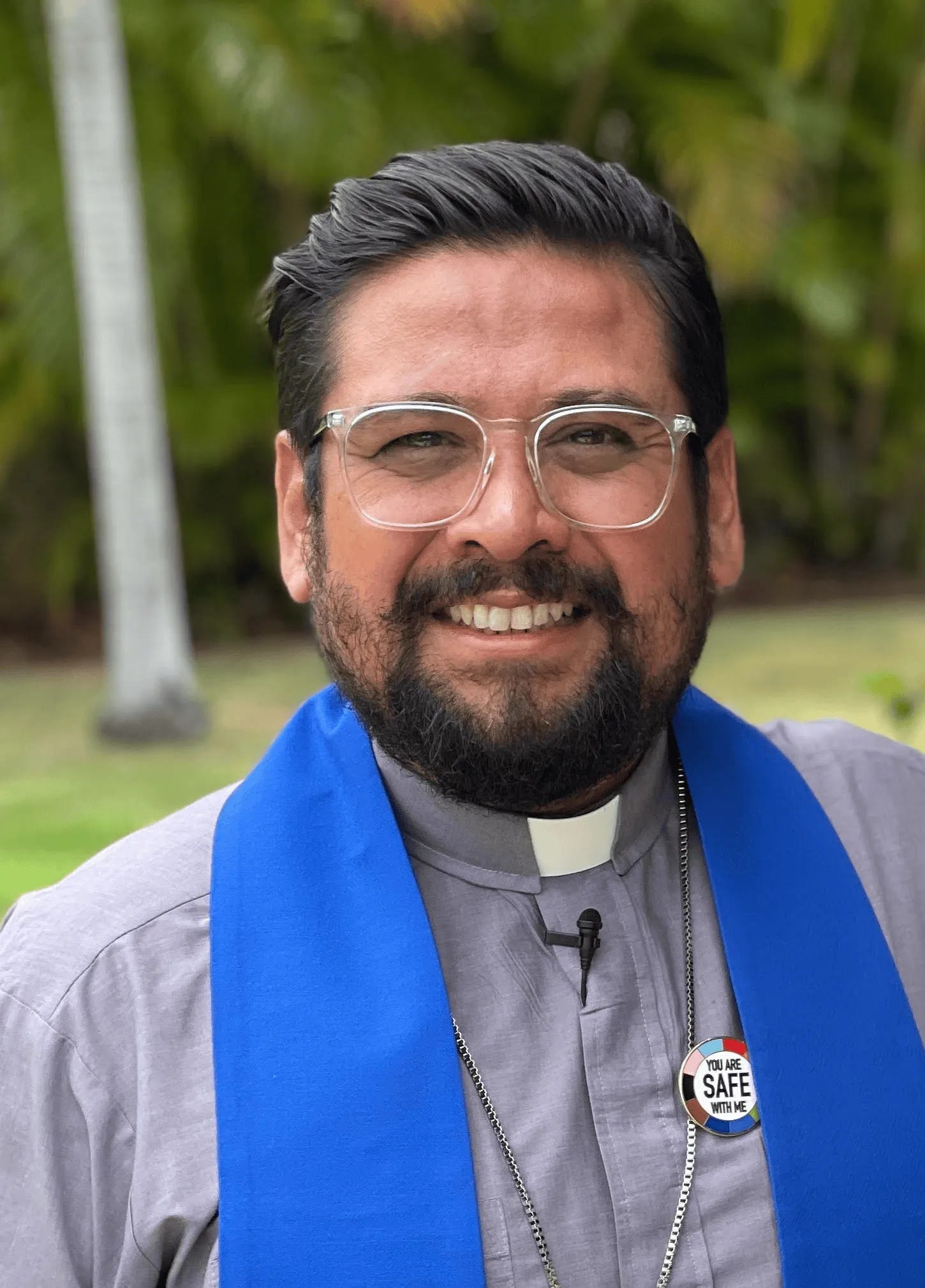
The Rev. Dr. Moses D. Barrios (el/he/him) is Pastor of St. Matthew Lutheran Church in Southwest Washington, D.C., Assistant to the Bishop of the Metro D.C. Synod, and Program Manager for Multiethnic and Intersectional Ministries with the Evangelical Lutheran Church in America (ELCA). An Indigenous American of Mayan descent whose family roots are in the Western Highlands of Guatemala and El Salvador, Rev. Barrios brings more than twenty-five years of ministry experience serving congregations in California, Hawai’i, and Washington, D.C. His ministry focuses on evangelism as invitation and belonging, congregational renewal, multiethnic and intersectional leadership development, justice-centered discipleship, and helping churches cultivate communities where all people can flourish.
A graduate of Fuller Theological Seminary, his doctoral work focused on confronting the lack of racial unity in the American church and building communities rooted in belonging, reconciliation, and liberation through Jesus Christ.
He is married to Brenda and is the father of three children. His ministry is grounded in the conviction that the cosmos is actively healing, reconciling, and renewing through the divine flow of the Creator, Redeemer, and Sustainer.
Resources
Websites:
Multiethnic and Intersectional Network, ELCA
Social Media:
Multiethnic and Intersectional Network, ELCA
YouTube:
Multiethnic and Intersectional Network, ELCA
Books:
-Many Colors: Cultural Intelligence for a Changing Church by Soong-Chan Rah
-After Whiteness: An Education in Belonging by Willie Jennings
-The Next Worship by Sandra Maria Van Opstal
-Reclaiming the “L” Word by Kelly Fryer
-Brown Church by Robert Chao Romero
-Roadmap to Reconciliation 2.0 by Brenda Salter McNeil
-A Theology of Liberation by Gustavo Gutierrez
-Ten Strategies for Becoming a Multiracial Congregation by Jacqui Lewis
-Manana: Christian Theology from a Hispanic Perspective by Justo L. Gonzalez
Copyright & Permission
Copyright © 2026 Rev. Dr. Moses D. Barrios. All rights reserved.
Permission is granted to congregations, synods, seminaries, and nonprofit ministries to reproduce, distribute, and adapt this article for educational, ministry, and congregational purposes, provided appropriate attribution is given to Rev. Dr. Moses D. Barrios and the original work is not sold for profit. Any commercial use, republication, or substantial modification requires written permission from the author.